
Last updated October 15, 2026
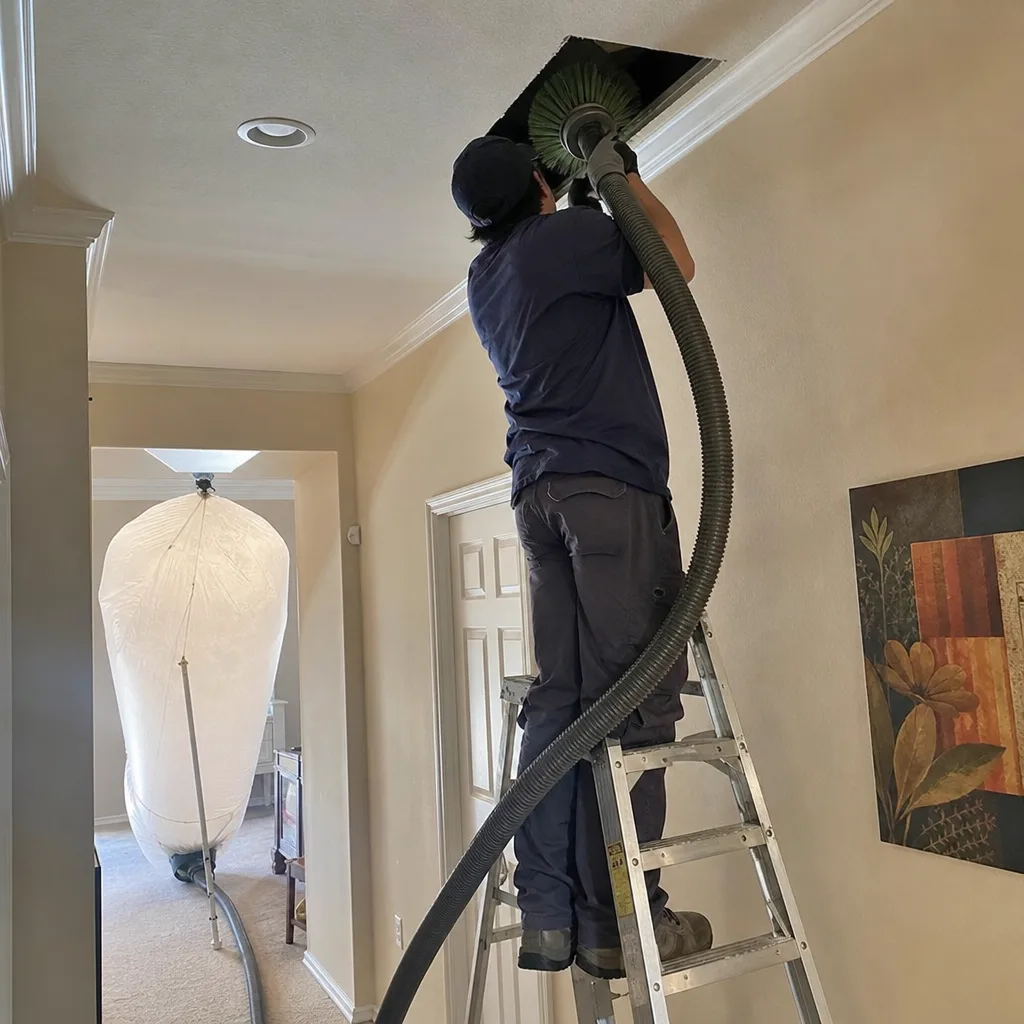
 Whole-home duct cleaning
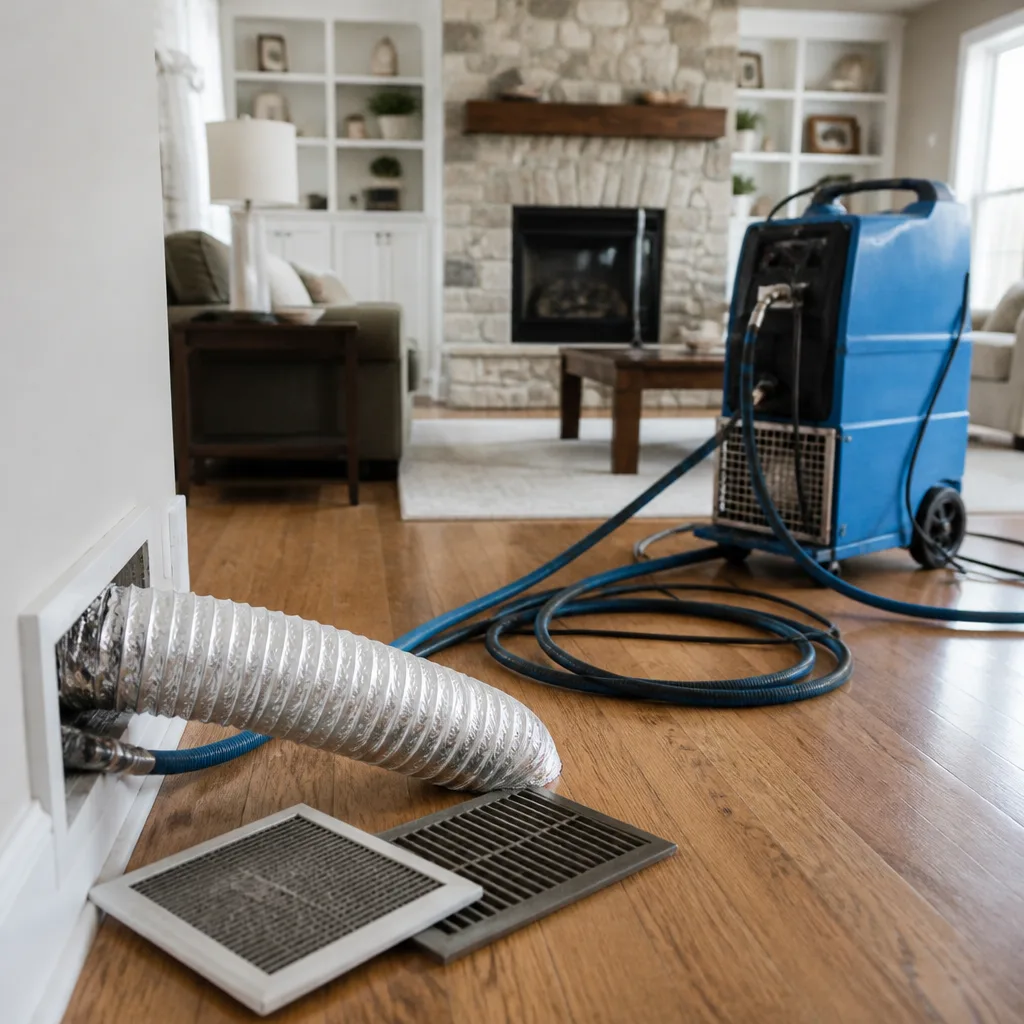
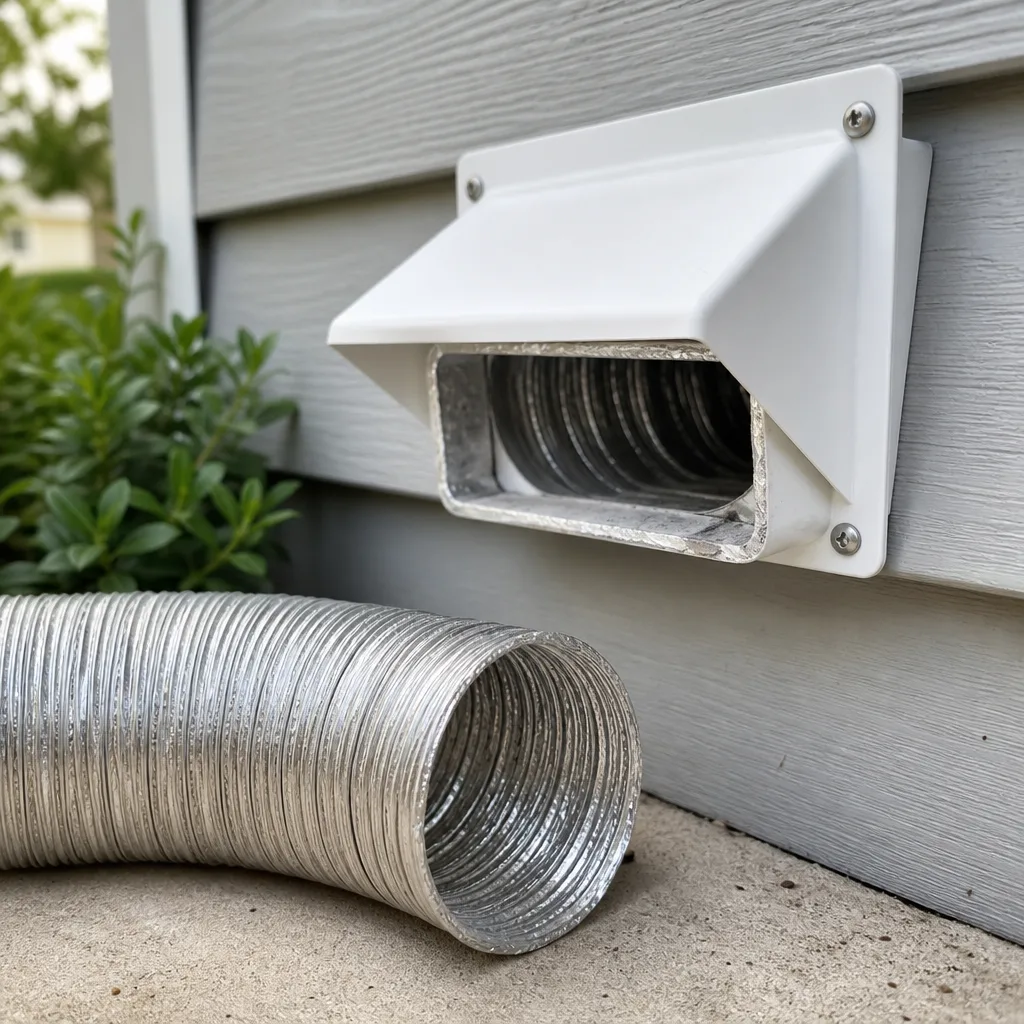 Dryer vent cleaning
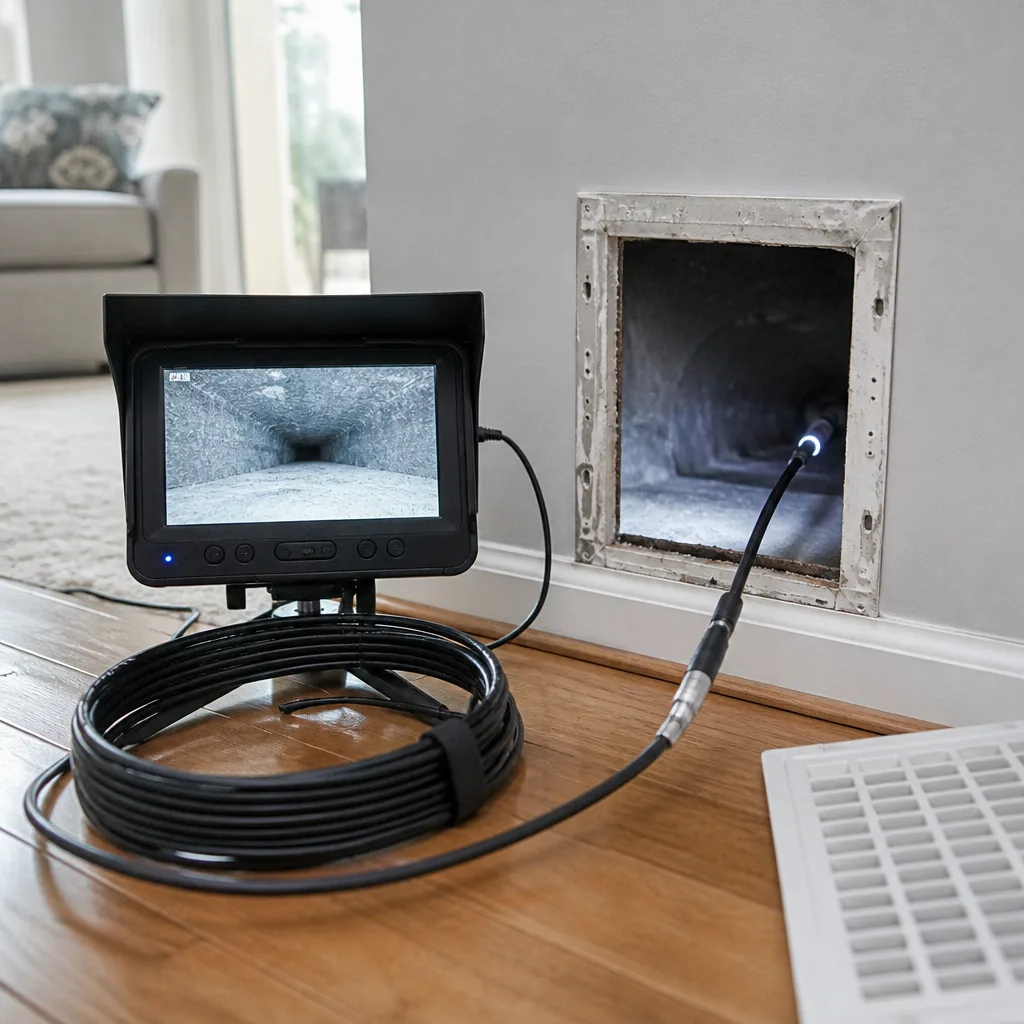 Camera inspection
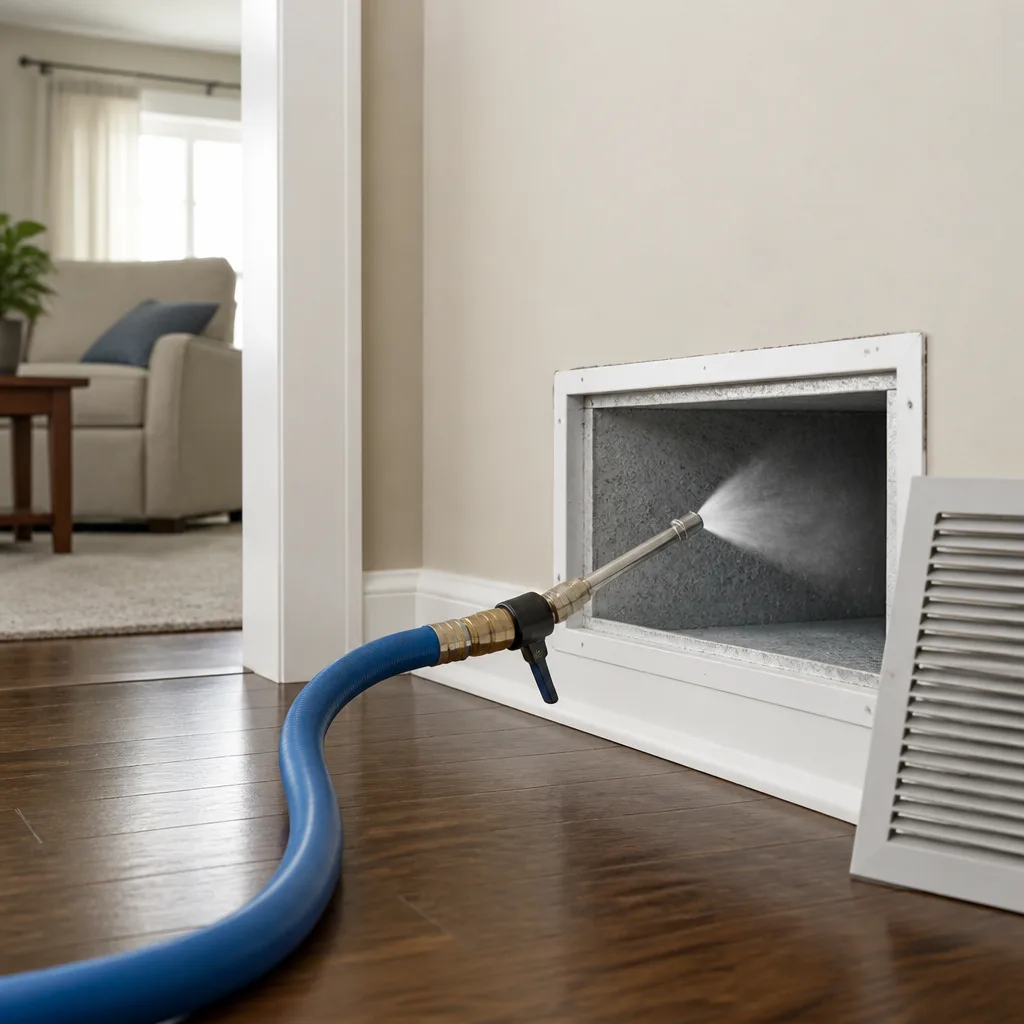 Sanitizing & deodorizing
Whole-system duct and dryer vent check with before-and-after photos - you see exactly what came out of your vents
That "$99 whole-house special" is a bait ad - the real number appears once they are in your hallway, or the "clean" is a shop-vac at the register. We photograph the inside of your ducts before and after instead.
DIY vs Professional Air Duct Cleaning: The Fort Worth Homeowner’s Decision Guide
A shop vac generates roughly 80 cubic feet per minute of suction. A professional truck-mounted negative-air system pulls 15,000 CFM or more. That gap in airflow is the entire reason DIY duct cleaning and professional source-removal cleaning are not interchangeable, regardless of how many YouTube tutorials make them look equivalent. This guide explains exactly what a Fort Worth homeowner can clean effectively with basic tools, what requires Air Duct Cleaning services, and how to use DIY maintenance as a legitimate cost-control strategy without fooling yourself into thinking it replaces the real job.
Styles & brands we work with
Quick Answer
DIY duct cleaning with a shop vac and register brush handles surface-level debris: register grilles, accessible return boots, and the first foot or so of visible supply runs. It cannot create the negative pressure required to clean trunk lines, and doing it wrong in a flex duct system can tear the inner liner and create a contamination problem worse than the one you started with. The decision is not about cost; it is about what the job actually requires.
Table of Contents
- What DIY Duct Cleaning Can Actually Do
- What DIY Duct Cleaning Cannot Do
- The Flex Duct Problem: Why Fort Worth Homes Are Vulnerable
- The Cost Math: When DIY Saves Money and When It Costs More
- The Equipment Gap: Consumer Tools vs Professional Systems
- A DIY Maintenance Protocol That Works Between Professional Cleanings
- How Professional Negative-Air Cleaning Actually Works
- Common Mistakes to Avoid
- When to Call a Professional
- Frequently Asked Questions
- The Bottom Line
What DIY Duct Cleaning Can Actually Do
Let’s be straight about what a homeowner with a shop vac, a flashlight, and a brush kit can accomplish. In our experience cleaning ducts across Fort Worth since 2004, we have never met a homeowner who could not handle register grilles and visible duct openings. Those are legitimately cleanable with basic tools, and doing so between professional cleanings makes good sense.
Here is the honest list of DIY-appropriate tasks:
- Register grilles and vent covers: Remove them, wash with warm soapy water, dry thoroughly, and reinstall. This removes the visible dust film that accumulates on every grille in a Fort Worth home within about four months of normal operation.
- Return air boots: The metal or plastic box behind the return grille is accessible by hand and usually holds a surprising amount of loose debris. A shop vac nozzle reaches most of it.
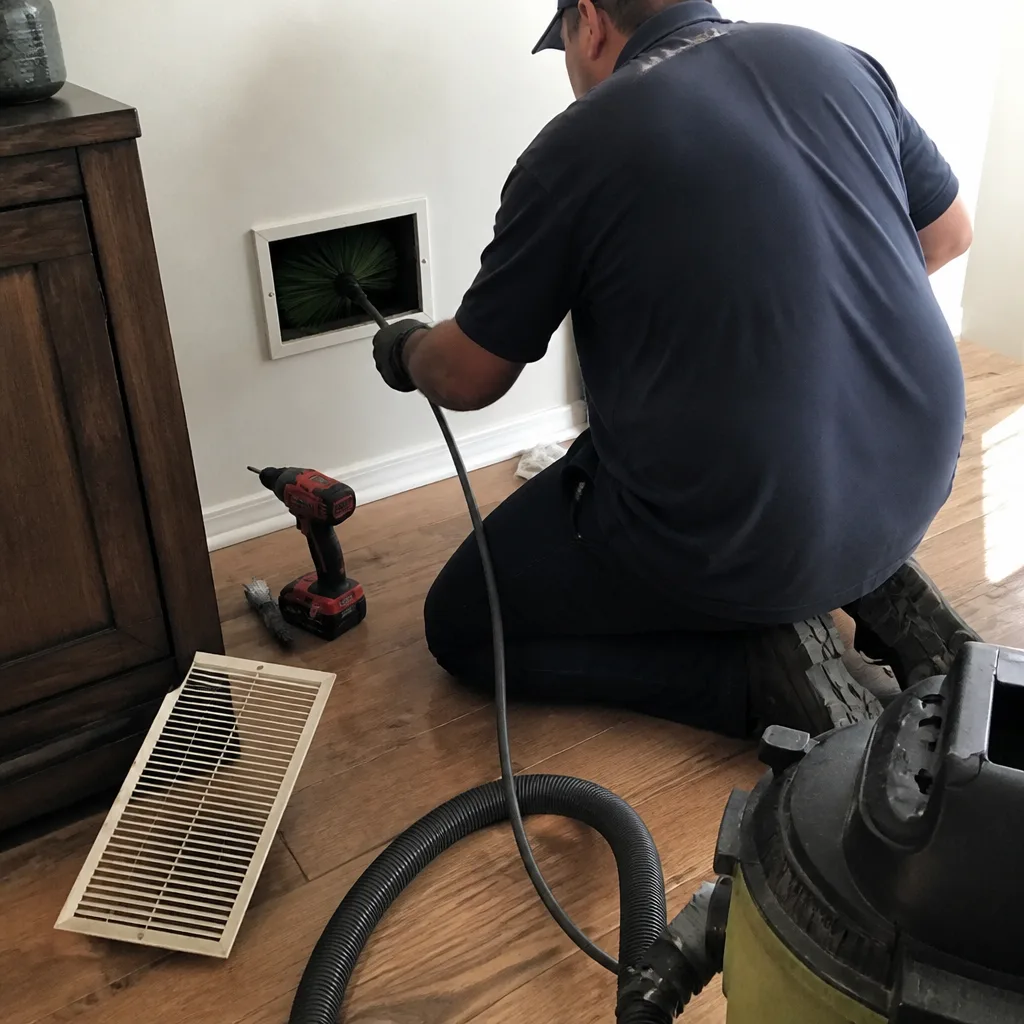
- The first 12 to 18 inches of visible supply runs: With the register off and a bright flashlight, you can see and reach the first section of the supply duct. A flexible shop vac hose with a brush attachment clears loose dust and the occasional toy or lost object.
- Filter replacement: This is not duct cleaning, but a clean filter at the return protects every duct downstream. In a Fort Worth climate where the HVAC runs hard from May through October, a monthly filter check is not excessive.
None of this touches the trunk lines that carry air through the attic or between floors. Understanding that limitation is the difference between DIY that helps and DIY that gives a false sense of a complete job.
What DIY Duct Cleaning Cannot Do
The trunk line is the large central duct that branches out to every register in the home. In most Fort Worth houses, it runs through the attic or a utility chase, carries all conditioned air, and accumulates the bulk of the dust, debris, and sometimes biological growth. A shop vac cannot clean it. This is not a sales claim; it is a mechanical fact.
Professional source-removal cleaning works by connecting a high-powered negative-air machine to the duct system. The machine creates strong negative pressure throughout the trunk line while rotary brushes or compressed air agitate debris off the duct walls. The debris is pulled by airflow toward the collection point, not pushed toward the living space. A shop vac, by contrast, pulls 80 CFM through a two-inch hose. The trunk line in a typical 2,000-square-foot Fort Worth home is 16 to 20 inches in diameter and runs 30 to 60 feet. At 80 CFM, the velocity inside that trunk is effectively nothing. You are not cleaning; you are stirring.
The physics are unforgiving. Duct cleaning requires enough airflow velocity to lift and carry debris particles through the system to the collection point. Professional systems achieve 15,000 CFM or more specifically because that velocity is the entire mechanism of the job. No consumer equipment available at a hardware store comes within two orders of magnitude of that number.
The Flex Duct Problem: Why Fort Worth Homes Are Vulnerable
Fort Worth homes built since the late 1980s overwhelmingly use flexible ductwork for supply and return runs. Flex duct is inexpensive to install, easy to route through tight attic spaces, and carries a particular vulnerability that DIY duct cleaning turns into a real risk.
Flex duct construction is simple: a helical wire coil wrapped in fiberglass insulation, covered by a plastic or foil outer jacket, with a thin inner liner separating the airstream from the insulation. The inner liner is typically 6 mil or thinner. When a homeowner pushes a brush kit with a spinning head or stiff bristles into a flex duct run, the brush catches on the wire coil, tears the inner liner, and exposes the fiberglass insulation to the airstream. Now the system is distributing insulation fibers through the house. The contamination is inside the duct, where the homeowner cannot see it and a shop vac cannot reach it.
We have seen this exact failure in Fort Worth homes from Wedgwood to Saginaw. The homeowner started with dusty registers and ended up with insulation fibers circulating through the air, requiring a professional repair that cost more than the original professional cleaning would have. Flex duct is a system with tight tolerances for what touches its interior surface. Consumer brush kits are not designed for flex duct, regardless of what the packaging says.
The Cost Math: When DIY Saves Money and When It Costs More
Professional air duct cleaning in Fort Worth for a typical single-family home ranges from $450 to $900 for the full system, depending on square footage, number of systems, and accessibility. That is a real number, and a real budget line for most families. So the question is not whether DIY can replace professional cleaning; it is whether DIY maintenance can extend the interval between professional visits in a way that actually saves money.
The math works like this:
- DIY-only approach: You clean registers and accessible openings yourself, never call a professional, and after five to seven years the trunk lines are carrying accumulated debris through the house. You have saved the cost of professional cleaning but now have a duct system that is actively degrading indoor air quality. The savings came at the price of the problem you were trying to solve.
- Professional-only approach: A full professional cleaning every three years. In Fort Worth, with the long cooling season and the dust the dry climate generates, a three-year interval for professional cleaning is reasonable for most homes. Cost over a decade: roughly $1,500 to $3,000.
- Hybrid approach: Professional cleaning every five years, with DIY register and boot maintenance every six months and filter replacement monthly. Cost over a decade: roughly $900 to $1,800, plus the modest time investment of the DIY work. The trunk lines stay clean because the professional work still happens. The registers stay clean because you maintain them. This is the approach that actually saves money without compromising the system.
Used correctly, DIY maintenance extends professional intervals and lowers total cost of ownership. Used as a replacement for professional cleaning, it compounds the problem while providing the illusion of having addressed it.
The Equipment Gap: Consumer Tools vs Professional Systems
The difference between what a homeowner can buy at a hardware store and what a professional truck carries is not a matter of degree. It is a difference in category.
A consumer shop vac produces around 80 CFM of suction at the hose end. A professional truck-mounted negative-air machine from Nikro or Abatement Technologies produces 15,000 CFM or more at the collection point. The professional machine is not a bigger version of the shop vac; it is a different tool built for a different job. The shop vac is designed to pick up sawdust and spilled cereal. The negative-air machine is designed to move enough air to evacuate an entire duct system while containing the debris.
Rotary brush systems from Rotobrush are similarly in a different category than consumer brush kits. A professional rotary brush runs on a motorized cable system that rotates at controlled speed, dislodging debris from duct walls while compressed air and negative pressure carry it out of the system. The brush head is sized to the duct. The cable is designed not to catch on flex duct coils. The operator controls direction and speed through a handheld unit. Compare that to a homeowner pushing a hardware-store brush kit by hand into a flex duct run with no visibility and no airflow, and the difference stops being a matter of technique and becomes a matter of what the tools can physically do without damaging the system.
Mention Honeywell filtration in this context and it makes the point in a different way. The air that leaves a professionally cleaned duct system passes through high-efficiency filtration before returning to the living space. The filtration is part of the process. A shop vac exhausts whatever it picks up right back into the room.
A DIY Maintenance Protocol That Works Between Professional Cleanings
This is the legitimate role of DIY in duct maintenance: keeping the accessible components clean so the professional cleaning can focus on what only professional equipment can reach. Here is the protocol we recommend to Fort Worth homeowners who want to stretch their professional intervals without compromising their systems.
Monthly
- Check the return air filter. If you can see accumulated dust when you hold it up to a light, replace it. In Fort Worth’s summer months, a filter can load visibly in 30 days.
- Wipe down visible register grilles with a damp cloth. Do this before dust becomes a visible coating. A quick wipe prevents baked-on grime that requires soaking later.
Every Six Months
- Remove all register grilles and wash them in warm soapy water. Dry thoroughly before reinstalling. This is a 20-minute job for most homes.
- Vacuum the return air boots. Remove the return grille, reach in with a shop vac, and clear loose debris from the boot. Do not push into flex runs beyond what you can see.
- Vacuum the first 12 to 18 inches of visible supply runs. With the register off and a flashlight, clear the visible section only. Stop where the duct curves or disappears from sight.
Annually
- Inspect what you can see of the duct system for obvious leaks, disconnected joints, or torn outer jackets. Flex duct that has sagged or separated in the attic is a repair job, not a cleaning job.
- Consider having your dryer vent cleaned professionally. Lint accumulation in dryer vents is a fire hazard, and the tools to clean it properly are not the same as the tools to clean air ducts. For Fort Worth homeowners, the dryer vent is a separate but equally important system.
- Schedule a professional assessment if you have never had your ducts cleaned or cannot remember when it was done. A professional can tell you whether the system needs cleaning now or can wait another year. That assessment should cost nothing.
This protocol keeps the accessible surfaces clean and gives you visibility into the parts of the system you can reach. It does not clean the trunk lines, and it should not pretend to. That is what the professional interval is for.
How Professional Negative-Air Cleaning Actually Works
Understanding what happens during a professional air duct cleaning in Fort Worth makes the DIY comparison concrete. Here is the process as we perform it, step by step:
- System inspection: Before any work starts, the technician inspects the duct system, identifies access points, checks for flex duct damage or disconnections, and confirms the scope of work in writing.
- Connection point: The technician cuts or opens an access port in the trunk line, usually in the attic or at the air handler, and connects the negative-air machine to the system. The machine’s vacuum hose seals to the system so all airflow moves in one direction: out of the ducts and into the collection unit.
- Negative pressure establishment: The machine pulls the system into negative pressure. Every register is sealed during this phase, so the only air entering the system comes in through controlled openings. Debris is pulled toward the vacuum, not blown into the house.
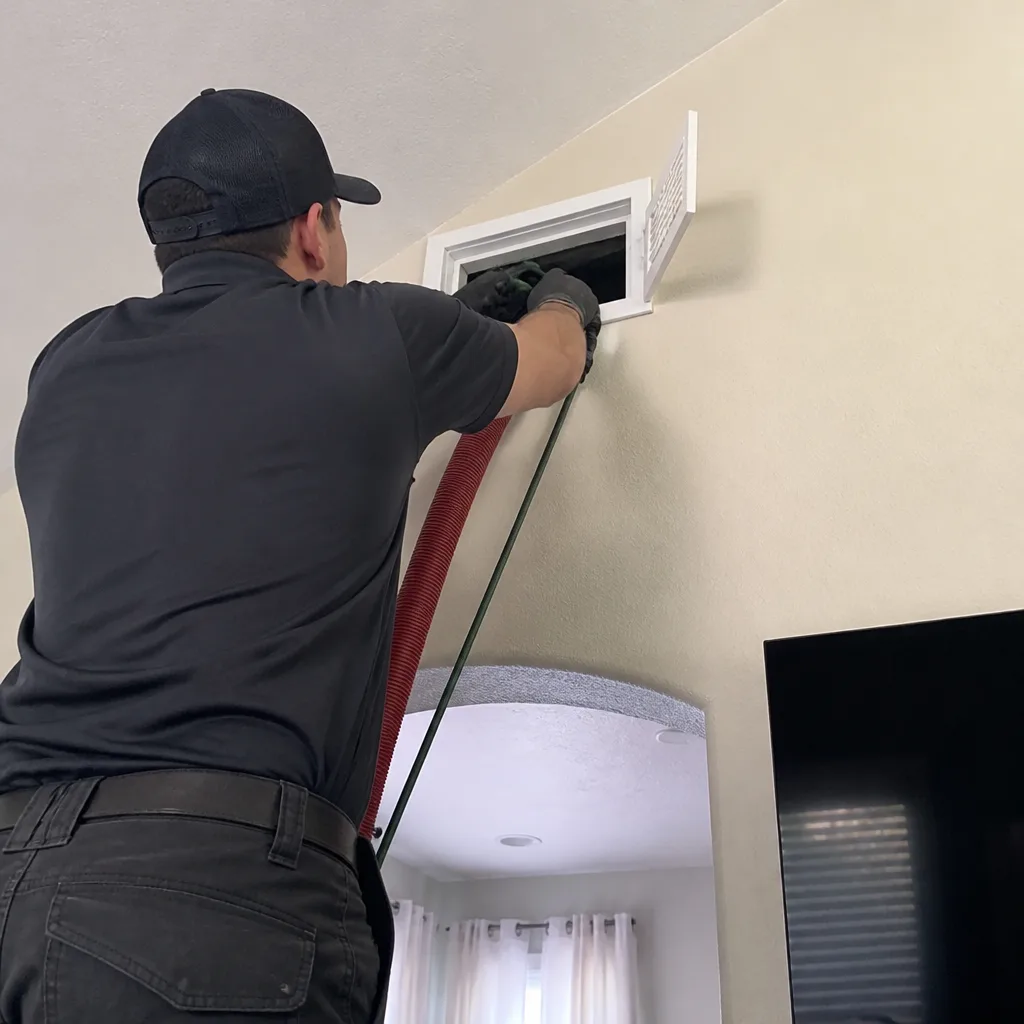
- Agitation: With negative pressure established, the technician runs a rotary brush through the duct runs, dislodging debris from the walls. The brush does not have to push the debris anywhere; it just has to loosen it so the airflow can carry it out. This is the step that cannot be replicated with consumer equipment, because consumer equipment cannot create the airflow that makes the agitation effective.
- Collection and filtration: Debris exits the system through the vacuum hose into the collection unit, which filters the air before exhausting it. The homeowner is not breathing the debris during the process.
- System check: After cleaning, the technician inspects the system again, confirms the access point is sealed properly, and verifies that no damage occurred during the process.
The entire job for a typical Fort Worth home takes four to eight hours, and the price is written before the work starts. That is not a small detail. A written price is the difference between a job you can budget for and a job where the invoice is a surprise.
Common Mistakes to Avoid
- Pushing a brush kit into flex duct runs. The brush catches on the wire coil, tears the inner liner, and contaminates the system with insulation fibers. This is the most common and most costly DIY mistake we see in Fort Worth homes. If you cannot see it, do not brush it.
- Using chemical sanitizers from a hardware store. Spraying chemicals into ductwork without the ability to remove the residue leaves a sticky film on the duct walls that attracts and holds dust faster than a clean surface would. The chemical becomes part of the problem.
- Vacuuming from the register side without sealing the rest of the system. A shop vac at one register pulls air through the path of least resistance, which is usually the closest return, not the trunk line. You move dust around the system instead of removing it.
- Forgetting the return side entirely. Many homeowners clean supply registers and never touch the return boots. The return side sees all the unfiltered air in the house. If the filter is upstream of the return boot, that boot can be the dirtiest part of the accessible system.
- Treating the dryer vent as part of the HVAC system. Dryer vent cleaning is a separate job with separate equipment and separate safety considerations. A clogged dryer vent is a fire hazard, and no amount of HVAC duct cleaning addresses it. For Fort Worth homeowners, this is a critical distinction in a climate where dryers run year-round.
- Skipping the filter because “the duct cleaner will handle it.” The filter is the first line of defense for every duct downstream. A loaded filter lets dust bypass it and enter the system. No professional cleaning fixes a homeowner who never changes the filter.
- Assuming the ducts need cleaning because the registers are dusty. Register dust is normal and is mostly handled by the DIY protocol above. The trunk line is a different question. Before paying for professional cleaning, have a professional tell you whether the system actually needs it. A legitimate company will give you an honest answer, not a sales pitch.
When to Call a Professional
Call a professional when the problem is beyond the reach of hand tools. If you see visible mold growth on duct surfaces or insulation, call. If you have had water in the ductwork from a roof leak, an HVAC condensation failure, or a plumbing issue, call. If the home had a pest infestation in the ducts, call. If someone in the household has respiratory symptoms that worsen in the home and the ducts have not been cleaned in five years or more, call. If you have flex duct runs with visible sagging, separated joints, or torn outer jackets, call for inspection and repair before the ducts are cleaned. And if you want the trunk lines cleaned because that is where the accumulated debris lives, that is a professional job by definition. Hollis Air Duct Fort Worth offers free estimates in Fort Worth. Call (682) 255-2572 and we will tell you whether the system needs cleaning or whether DIY maintenance is enough for now. A straight answer costs nothing.
Frequently Asked Questions
DIY cleaning is worth doing only as a maintenance routine for register grilles, return boots, and the visible first section of supply runs. It cannot clean trunk lines, and attempting to do so with consumer tools risks damaging flex duct, which is the dominant duct type in Fort Worth homes. As a cost-control measure between professional cleanings, it is genuinely useful. As a replacement for professional cleaning, it compounds the problem.
Professional air duct cleaning in Fort Worth ranges from $450 to $900 for a typical single-family home, depending on square footage, number of systems, and attic accessibility. The price should be written before any work begins. If a company quotes you a price before seeing the system and then raises it at the door, that is a red flag, not a negotiation. Call (682) 255-2572 for a written estimate for your specific system.
Most Fort Worth homes need professional cleaning every three to five years, depending on household factors. Homes with pets, smokers, recent construction, or occupants with respiratory conditions trend toward the shorter end of that range. The Fort Worth climate, with its dry, dusty summers and long cooling season, tends to load duct systems faster than humid climates where dust settles out of the air. See our Seasonal Air Duct Cleaning Care for Fort Worth: Year-Round Homeowner’s Guide for timing tips. A hybrid DIY maintenance routine can extend the professional interval from three years to five years without compromising the system.
A shop vac can clean register grilles, return boots, and the first 12 to 18 inches of visible duct runs. It cannot clean trunk lines because it generates roughly 80 CFM of suction, while effective duct cleaning requires 15,000 CFM or more to create the airflow velocity that carries debris out of the system. The physics make the shop vac a maintenance tool, not a cleaning tool.
A torn inner liner exposes the fiberglass insulation to the airstream, which then distributes insulation fibers through the house every time the HVAC runs. The repair requires cutting out the damaged section and replacing it, which is a professional job. In our experience across Fort Worth, DIY-caused flex duct damage typically costs more to repair than the original professional cleaning would have. If you have flex duct, do not push anything into it that you cannot control.
The bait-and-switch pricing model in the duct cleaning industry is a legitimate problem, and Fort Worth homeowners are right to be skeptical. The job itself is real and physically measurable: negative-air source-removal cleaning removes debris from duct systems that no consumer equipment can reach. The scam is not the job; the scam is quoting a low price and raising it at the door. The defense is simple: get the price in writing before work starts, and refuse to pay a penny more than the written number. Every job we perform at Hollis Air Duct Fort Worth carries a written price agreed before we touch the system.
The Bottom Line
DIY duct cleaning has a legitimate role: keeping the accessible surfaces clean so the professional interval can stretch without compromising the system. It does not replace professional cleaning, because the physics of negative-air source removal cannot be replicated with consumer equipment. Fort Worth homes, most of which use flex duct, carry a particular risk for DIY damage that can turn a maintenance project into a repair bill. The smart play is the hybrid approach: DIY maintenance every month and every six months, professional cleaning every five years, and an honest conversation with a professional before you decide whether the system needs the full job. That conversation should be free, and the price should be written before anyone touches your ducts. For more guides & resources, visit our blog.
For more on what a full professional cleaning involves, see our guide to air duct cleaning in Fort Worth. If your dryer vent is also overdue for attention, read about dryer vent cleaning in Fort Worth. And if your duct system has leaks or damage that cleaning will not fix, our duct sealing in Fort Worth page explains how we address those problems. Each of these is a separate job with separate tools and separate standards. A written estimate tells you which ones your home actually needs. Call (682) 255-2572 to schedule one.
Written by Roy Castellanos, Owner at Hollis Air Duct Fort Worth, serving Fort Worth since 2004.
See the difference
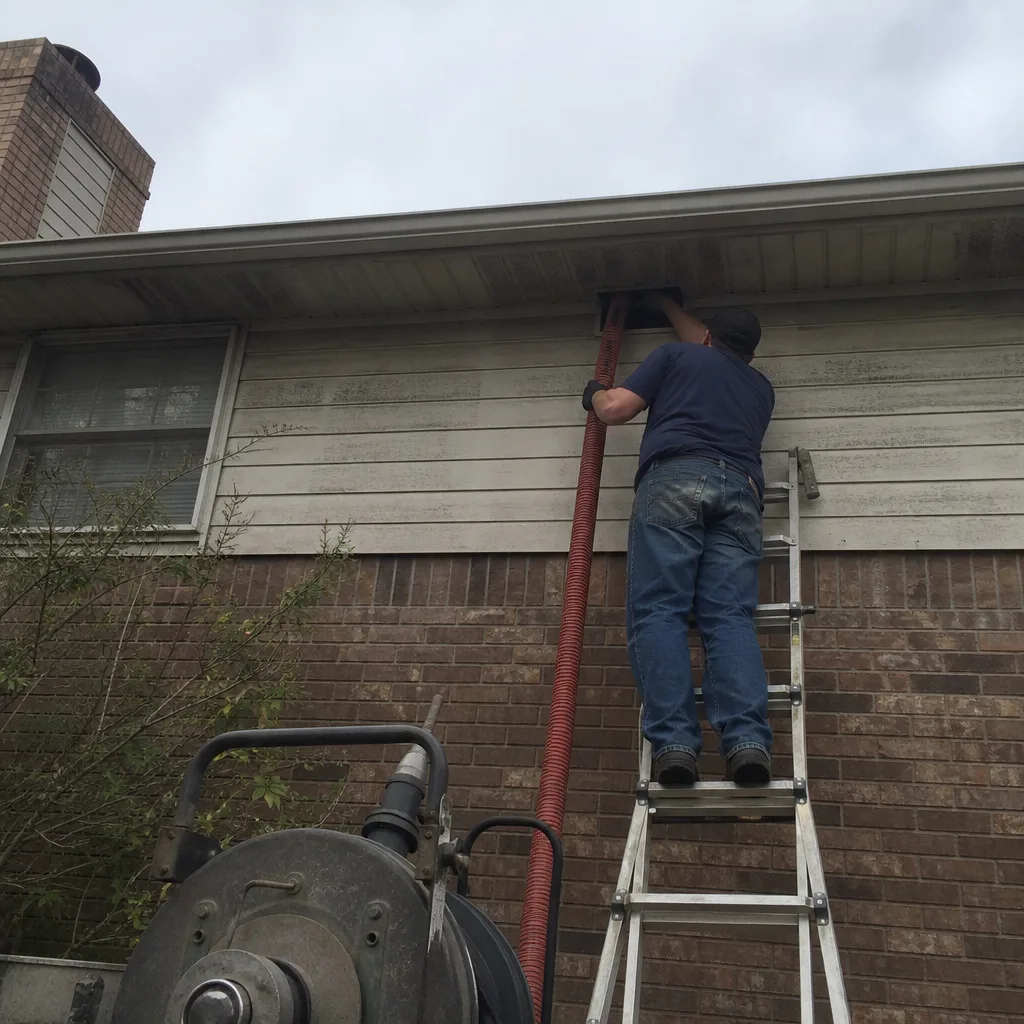 Before
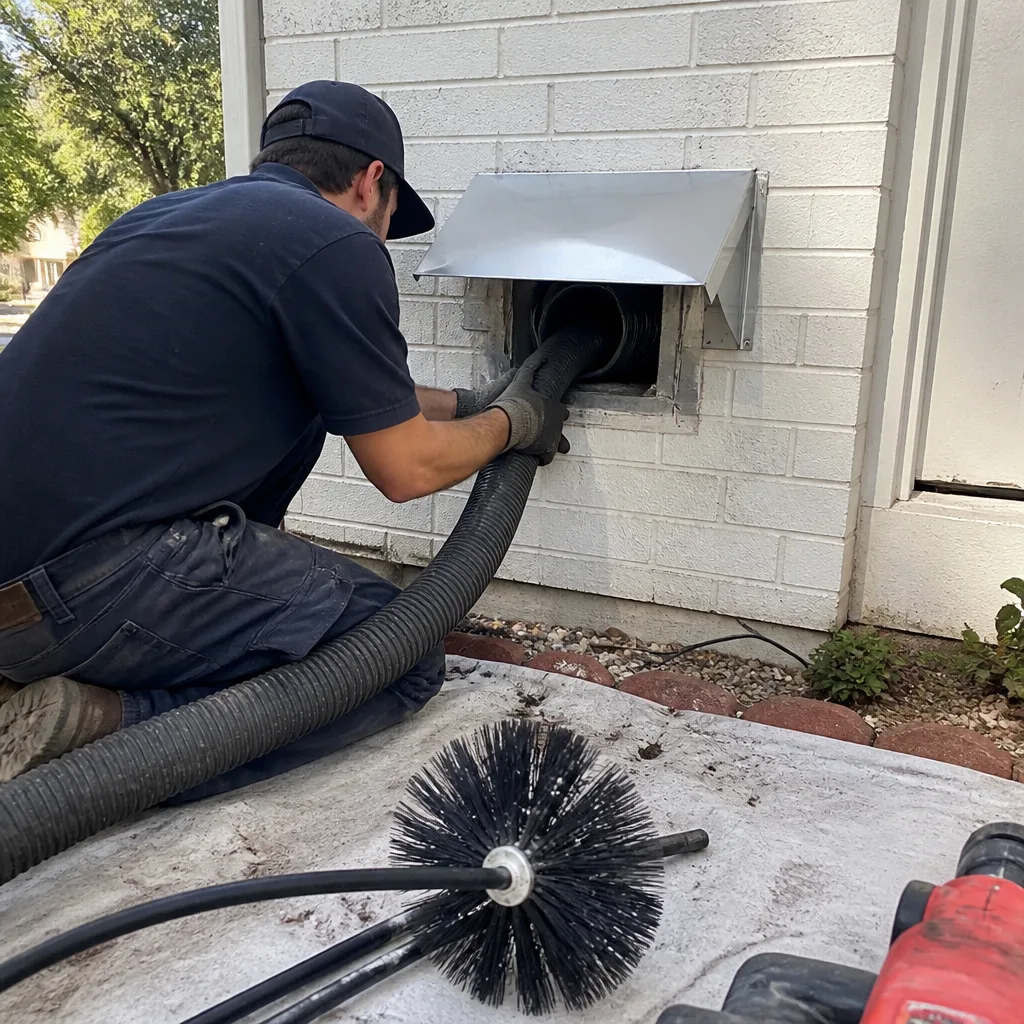 After
After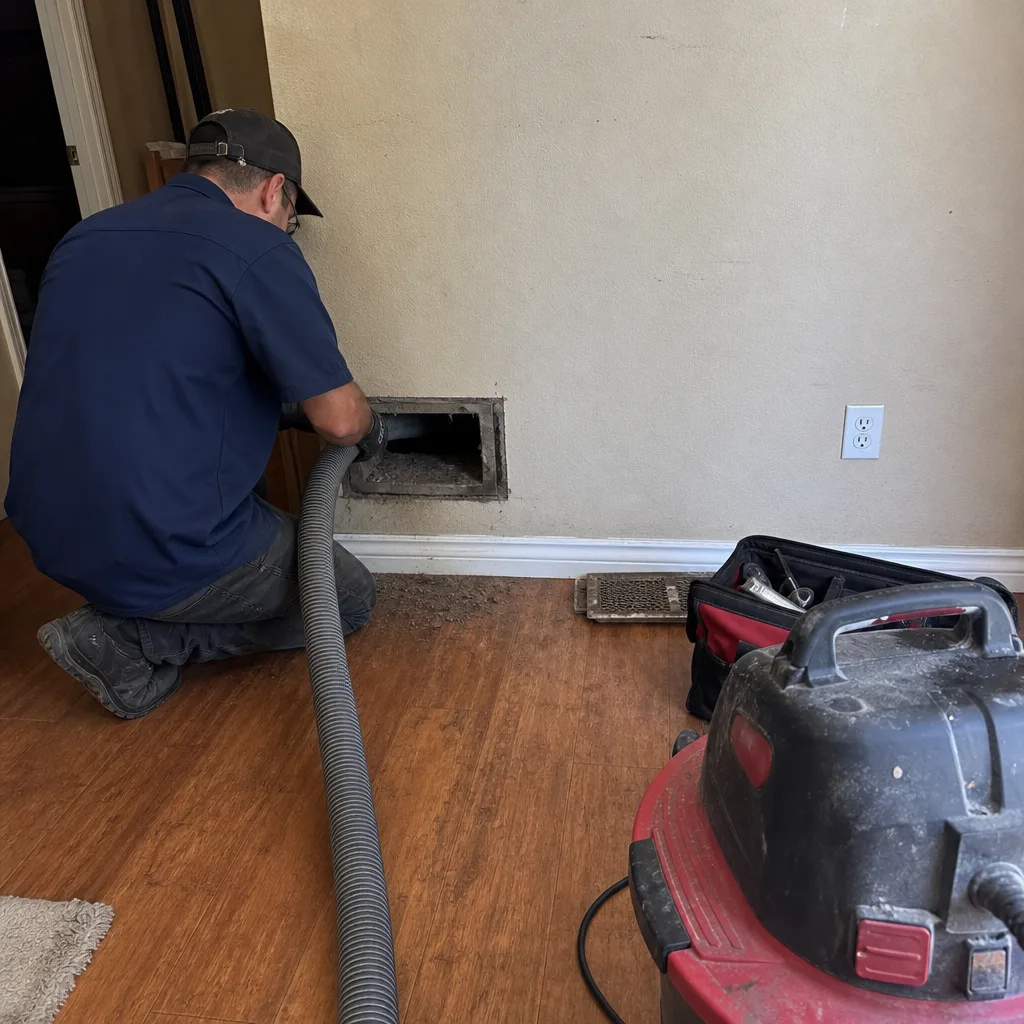 Before
 After
After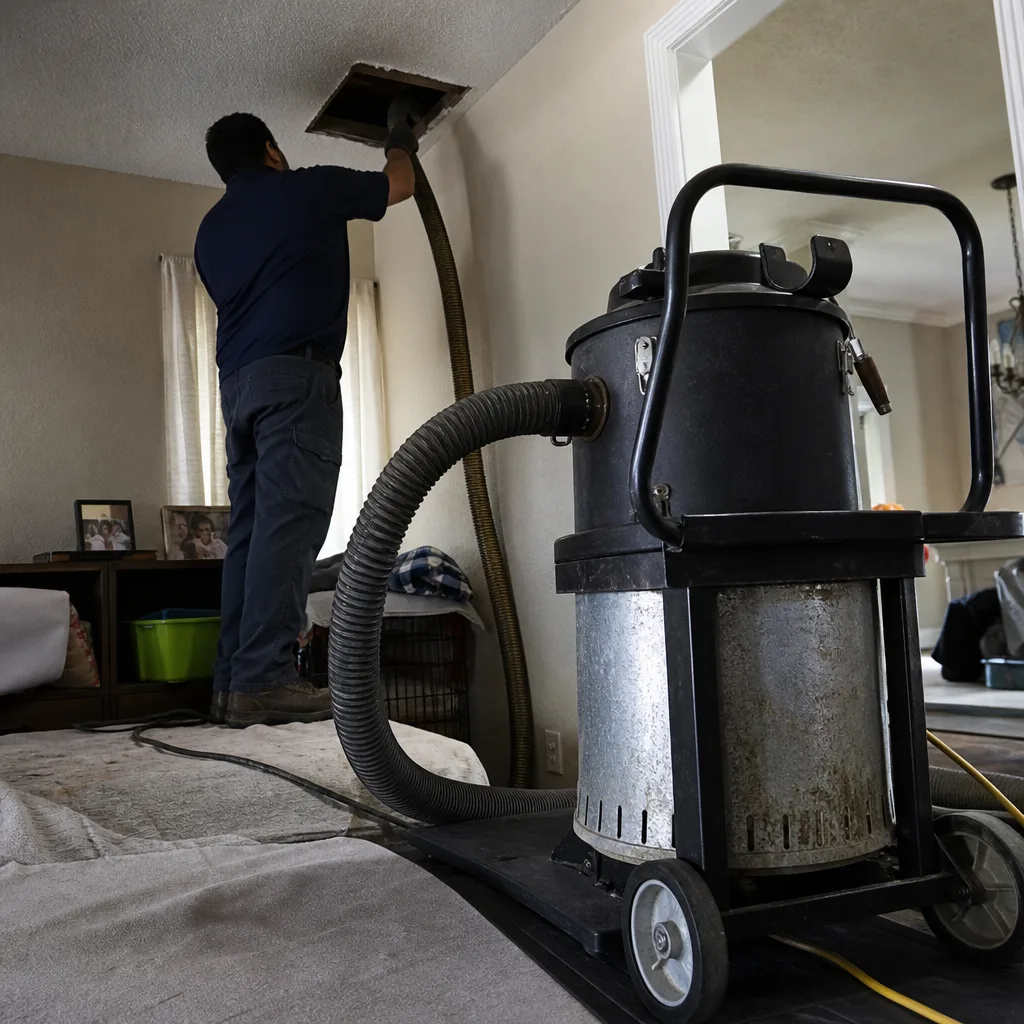 Before
 After
After